
A couple weeks ago I took in a presentation at the Agowiidiwinan Centre at the Forks, part of a speaker series by the Treaty Relations Commission of Manitoba. In a thoughtful and eye-opening walk through an often-neglected history, Andrea Gallagher-Courteau an Anishinaabekwe justice worker from Sagkeeng First Nation spoke about Gender Discrimination in and around The Indian Act–a crucial lens examined not nearly enough. And I was struck again by the many ways we (meaning the settler colonial society in which I’m embedded) have intentionally silenced and still silence Indigenous women. For example, treaty making that ignored women and suppressed matriarchal leadership, as well as laws forbidding women to participate in band council elections for nearly a hundred years has meant some communities are just beginning to regain trust in women leaders. Or the multiple ways enfranchisement (taking away First Nation status) was disproportionally forced on women and children through marriage, including the complicated second generation cutoff rule that continues to remove status from some women, including within the speakers family. Or the non-Indigenous male Indian agents that controlled and much too often violated the rights, needed services, and bodies of women, which has evolved into the epidemic of Missing and Murdered Indigenous Women, Girls, and Two-Spirited individuals.
But what especially struck me from her presentation is how connected this all has been to the land–to the taking of land–whether through disallowing women to pass on land to their children, or the loss of connection to land-based lifestyles through enfranchisement and cultural genocide, or the physical displacement from land through Residential Schools and the child welfare system. As the late Winnipeg Indigenous educator and social worker Larry Morissette said, “If you have your language, then you have your culture. And if you have your culture, you will keep your attachment to the land. Residential schools were designed to cut aboriginal peoples’ feet from the land by taking away their language and culture.”
Most of the time when something is taken forcibly, something of value to which the taker has no connection, it simply won’t be valued in the same way. When settlers usurped this land, sadly, we too often “trashed” that same land with our careless extraction and consumption, our unfettered need for production, sometimes intentionally and at other times shortsightedly.
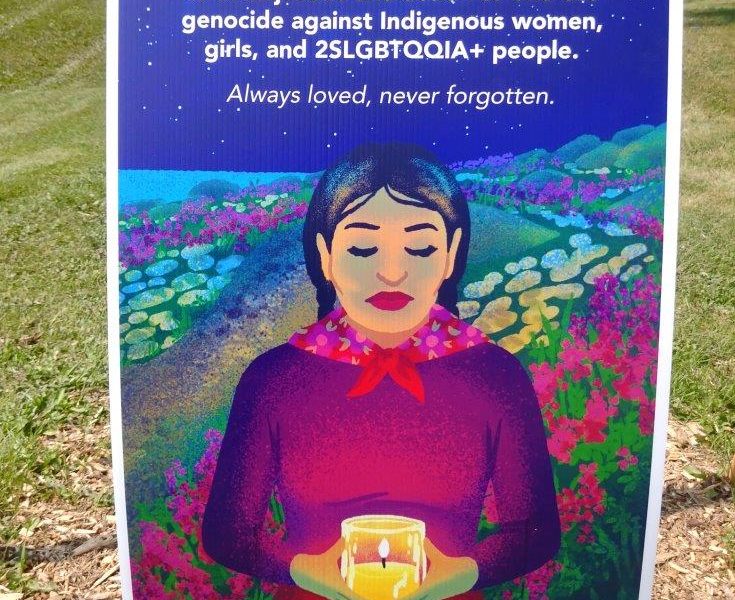
This is what has made the Indigenous-led Search the Landfill movement here in Winnipeg doubly tragic and poignant–that we would need to search for women’s silenced bodies in the desecrated land we use to discard the consumed resources that we consider waste. Last week the province announced they will begin the landfill search for the bodies of Ashley Shingoose, who was known as Mashkode Bizhiki’ikwe/Buffalo Woman until her identity was confirmed, and Tanya Nepinak. This is another valuable step in bringing a degree of closure for families and sending a message that Indigenous women are valuable and do NOT deserve to be buried under our garbage. Yet there are so many other missing individuals still to be located and hundreds of silenced lives that need to be named.
We have a lot of repair to do. Perhaps, we have a lot of healing to do too. And I’m thinking here of those of us non-Indigenous folks who are still circling in cycles of patriarchy and consumerism and colonial racism. I know these are loaded terms, ones that sometimes even (unhelpfully) bring up my own defenses. Yet as a white male settler person writing this post, it has been a week to step back again and examine the waters I swim in. I haven’t made direct choices that led to violent tragedies like the silencing of Ashley Shingoose. But I know that I can step on a bus or walk down a city street in the evening with minimal thought about my own safety, while some others might be wary of me for that same reason. I know that I have a graduate education, good employment and a safe home, at least in part because of a society that still privileges folks with my social identity, as well as the benefits of land colonized by my ancestors and the resources it still provides my family. And Gallagher-Courteau reminded me that there is a whole history of laws and institutions that have upheld these privileged “structures.”
Which is also why we need new institutions to begin to shift some of these realities. In the last couple weeks, the final report on the Red Dress Alert system was launched, an Indigenous led initiative to quickly mobilize critical services, including sending notifications to peoples phones, when a vulnerable Indigenous person goes missing. The province has yet to commit to creating Red Dress alert legislation, so something I could do is to advocate that this is funded and supported well. And even if I don’t hold relationships with families to support them directly, I can show up when their lives are being remembered. Another bit of proposed legislation I learned about from the talk is federal Bill S-2 seeking to amend the second-generation cutoff rule. Discrimination like this in our constitutional structures is one more form of control, which is how patriarchy and colonialism persist on both the macro and micro levels.
There are lots of ways that I can engage and these are just a few places where I can start. I also hope I can use my words and actions to stand up when women’s words, leadership, or safety are being silenced. I can also wear a Moose hide pin to demonstrate my commitment to ending gender-based violence. And I can offer financial reparations to support Indigenous led initiatives addressing such violence.
The Calls for Justice issued by the National Inquiry on Missing and Murdered Indigenous Women, Girls and 2SLGBTQQIA people are also really helpful in discerning what can be done. Share the Gifts-Honour the Treaties is part of the Winnipeg Indigenous Accord which invites local organizations to make specific commitments around these Calls for Justice, as wells as the 94 Calls to Action of the Truth and Reconciliation Commission. As an organization, in response to Calls for Justice for All Canadians 15.2 (decolonizing to learn our true history) and 15.4 (becoming a strong ally), Share the Gifts-Honour the Treaties has committed to continue expanding our own understanding and information on our website concerning MMIWG, including acting on structural reparations through advocacy on issues related to MMIWG. Here’s one small step towards this. What else could we do together?
 Podcast: Share the Gifts: Honour the Treaties shows Indigenous reparations in action
Leave a Reply